
Why Velocity Washer Supports Canada’s Defence Industrial Strategy: Serviceability, In‑Service Support, and Keeping Ageing Fleets Operational
Executive summary
Canada’s Defence Industrial Strategy (DIS) is unusually explicit about outcomes that matter to naval operators and in‑service support (ISS) organizations: within 10 years it aims to raise maritime fleet serviceability to 75%, and it identifies In‑Service Support (Naval; Land; Air) as a key sovereign capability to be prioritized for build‑in‑Canada procurement. [1]
At the same time, Canada’s own public reporting shows an acute readiness and sustainment gap. In 2023–24, DND reported maritime key fleet serviceability of 45.73% against a target of at least 60%, and noted that Halifax‑class frigates experienced longer Docking Work Periods primarily due to the age of the class. [2] DND evaluation work further links ageing platforms to Docking Work Periods (DWP) and Extended Docking Work Periods (EDWP) “routinely exceeding their programmed hours,” reducing operational availability. [3]
Against that problem set, the Velocity Washer is best understood not as a marginal fastener accessory, but as a maintainability and schedule‑risk reduction mechanism for bolted joints that must be opened repeatedly over a platform’s life. Velocity Bolting describes it as a “mechanical release washer” that uses standard torque procedures in assembly, then releases clamp load during breakout after about 12° of nut rotation, preventing galling/seizure and making disassembly predictable and fast. [4] Its published case studies report 112 hours of increased production (from avoided bolting delays) and 94% faster disassembly for a 32‑bolt cover plate application. [5]
For a defence‑industry audience, the core DIS alignment argument is straightforward: serviceability is constrained by maintenance time, parts availability, workforce capacity, and predictability. DIS is explicitly targeting all four levers (serviceability targets, ISS as a sovereign capability, supply chain security, and workforce development). [6] Velocity Washer maps cleanly to these levers as a drop‑in sustainment enabler that reduces unplanned maintenance friction and the need for destructive removal, specialised hot work, and repeat replacement of hardware - while also being designed to withstand shipboard vibration/shock environments. [7]
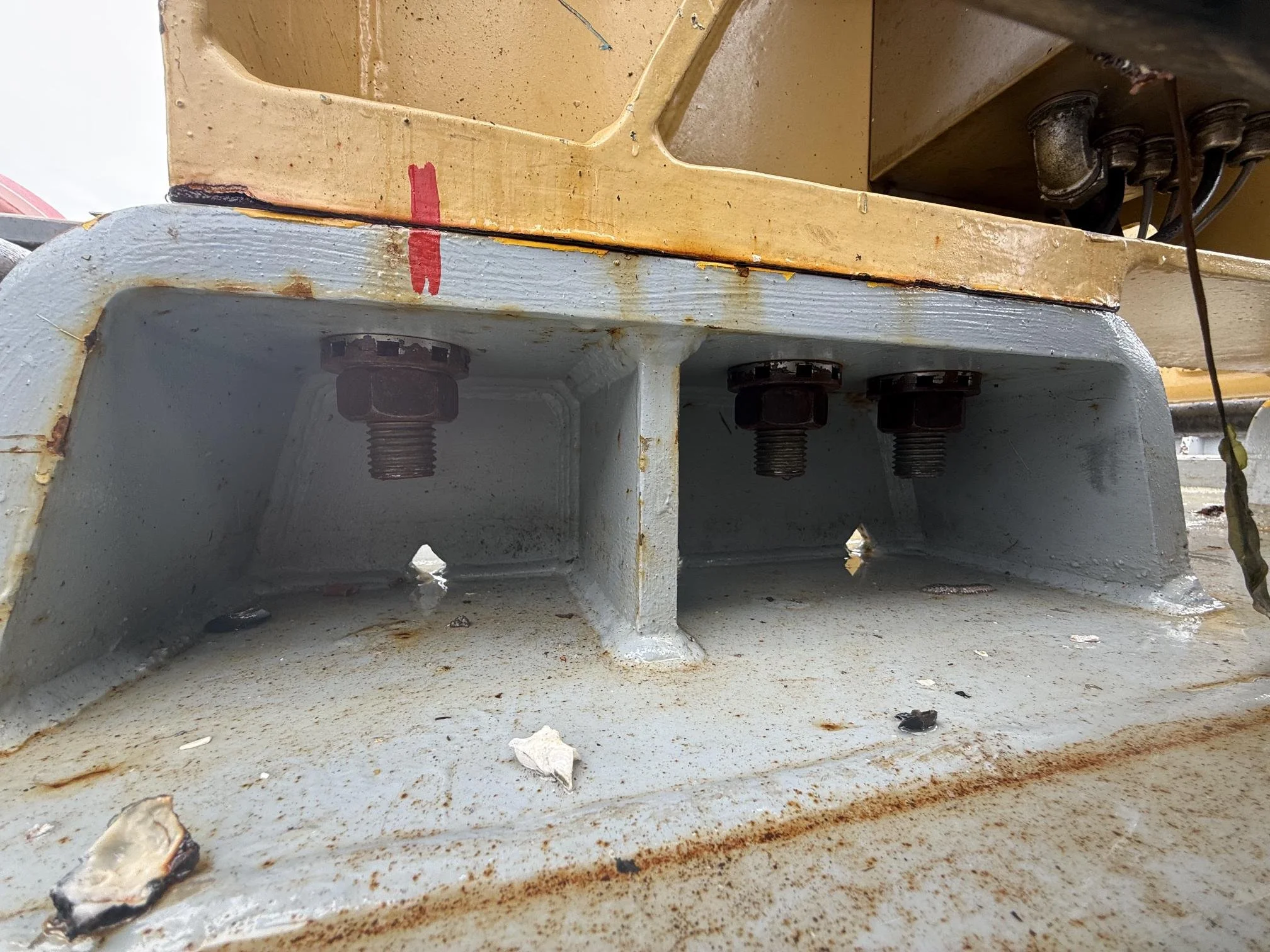
Velocity Washer being used on a Canadian Coast Guard vessel
What the Defence Industrial Strategy is optimising for
The Canadian DIS frames defence industrial capacity as a sovereignty and readiness prerequisite, implemented through a new Defence Investment Agency and a Build–Partner–Buy framework that prioritizes building in Canada - especially for sovereign capabilities—and insists on conditions that preserve Canadian “sovereign control” (including over operation and sustainment) when partnering or buying. [8]
For sustainment stakeholders, several DIS elements are directly relevant:
Canada’s published DIS “next 10 years” targets include raising maritime fleet serviceability to 75% (and land/aerospace to 80%/85%), and increasing the share of defence acquisitions awarded to Canadian firms to 70%. [9]
The DIS explicitly lists In‑Service Support (Naval; Land; Air) as a key sovereign capability for which build‑in‑Canada will be prioritized. [10] DIS consultation findings also emphasize that sovereign capabilities should include in‑service support, maintenance, repair, and overhaul services - signaling that sustainment is not an afterthought but a designed‑in industrial priority. [11]
The DIS points to procurement reform priorities that favour predictability and through‑life models, including “greater use of multi‑year contracts and lifecycle sustainment models.” [12] That language is important: DIS is signalling that procurement should reward solutions that reduce through‑life risk and stabilize industrial capacity, not just deliver initial equipment.
Finally, DIS places supply chain resilience and workforce development on equal footing with procurement: it dedicates a pillar to securing supply chains for key inputs and goods, including programmes intended to increase domestic production capacity, and it sets out a Canada Defence Skills Agenda to address skilled labour needs in defence industry. [13]
In short, DIS is pushing the ecosystem toward measurable readiness outputs (serviceability) backed by sovereign sustainment capability (ISS/MRO), secure supply chains, and a scalable workforce. [6]

Velocity Bolting founder, Ryder Britton, with Minister of National Defence (Canada), David McGuinty
The operational maintenance reality DIS is responding to
Public DND reporting shows that DIS’s serviceability ambition is not incremental - it is corrective.
In 2023–24, DND reported that the % of maritime key fleets serviceable to meet training/readiness requirements was 45.73% (with a target of at least 60%). [14] In the same results reporting, DND notes that the Royal Canadian Navy did not meet serviceability targets due to ageing fleets and that Halifax‑class frigates experienced longer docking work periods and post‑docking reactivations, primarily attributable to the class’s age. [15]
DND’s own evaluation of Ready Naval Forces describes the mechanism: preventive and corrective maintenance backlog accumulates over a frigate operational cycle, increasing workload during work periods, while ageing platforms require more repair. [3] Crucially for ship availability, the evaluation states that increasing maintenance and repair demand has resulted in ship and submarine DWP/EDWP routinely exceeding programmed hours, with a “resultant reduction” in operational availability. [3]
This is not just a technical problem; it is an industrial‑support and logistics problem. DND’s evaluation flags spare parts/obsolescence issues, including situations where parts are manufactured internally or transferred from units in docking periods or reduced readiness - actions that add labour demand and can introduce further risk. [3] Separately, Canada’s Auditor General concluded (in a supply chain audit) that National Defence often did not deliver on time requested materiel, highlighting the importance of reliable, localised, and predictable sustainment supply chains if serviceability is to be improved. [16]
Internationally, official defence oversight bodies emphasise similar readiness dynamics. The U.S. GAO notes that high‑priority planned ship/submarine maintenance often happens pier‑side in homeports, allowing ships to get underway quickly if needed, and describes these intermediate maintenance periods as “critical to fleet readiness.” [17] This matters because technologies that reduce time and uncertainty in maintenance tasks are not just cost savers - they are readiness multipliers.
Finally, lifecycle economics amplify the argument for sustainment innovations. A GAO review of a U.S. Navy ship programme states that operating and support costs make up approximately 70% of total programme life‑cycle costs of Navy ships. [18] Even though that statistic comes from a U.S. programme context, it reinforces the DIS logic: if most cost and risk live in sustainment, then high‑leverage sustainment improvements are strategically material.
What Velocity Washer adds, based on Velocity Bolting’s published evidence
Velocity Bolting’s own product page and news posts collectively position Velocity Washer as a maintainability technology: it aims to preserve the ability to disassemble bolted joints quickly and repeatedly over long service lives - especially where galling otherwise drives schedule risk, hot work, and collateral damage.
Mechanically and procedurally, Velocity Bolting describes the washer as a drop‑in replacement for a standard hardened washer: during assembly it is torqued using normal procedures, and it is engineered to replicate the friction factor (“k‑factor”) of a standard hardened washer so preload methods remain unchanged. [19] During removal, the nut is rotated a small amount (described as ~12°), the washer “pops”/collapses to relieve clamp load, and the nut can then be run off with minimal resistance - preventing thread galling that normally occurs when turning a loaded nut. [20]
Performance claims and field outcomes in Velocity Bolting’s published materials include:
Velocity Bolting states a “100% success rate across all global installs” in preventing galling (manufacturer‑reported). [21]
Two headline case studies published by Velocity Bolting report 112 hours of increased production (avoided delay) and 94% faster disassembly for a 32 × 3.25" bolt cover plate application (customer‑supplied data, per the product page). [5]
Operationally relevant logistics claims include “no special tools” and using the “same bolting procedures,” positioning Velocity Washer as a low‑integration‑burden sustainment improvement rather than a tooling overhaul. [22]
The product page and related technical posts also describe the washer as engineered for high‑vibration environments, claiming conformance testing against MIL standards including MIL‑STD‑167‑1A and MIL‑S‑901D. [23] Those standards are explicitly shipboard vibration and shock‑testing frameworks used by the U.S. Navy (useful proxy context for naval equipment robustness, although defence procurement would still require programme‑specific qualification evidence). [24]
Integration constraints - important for defence maintainers - are clearly stated in an external installation/operation guide: only one Velocity Washer is used per bolt; it must be installed on the side where torque is applied for torque‑up and breakout; it must not be lubricated at the flange contact surface; it should not be reused after activation; and it cannot be used on left‑hand threads. In addition, Velocity Bolting’s own engineering guidance stresses that washer height (reported as typically 0.38–0.72 inches) must be included in grip‑length calculations to avoid compromising nut engagement. [26]
From a “deployment example” standpoint, the Velocity Bolting news posts are dominated by high‑consequence maintenance environments (heat exchangers, reactors, flanged joints) where seized fasteners drive unpredictable delays and unsafe removal methods. For instance, a Velocity Bolting post describing heat exchanger maintenance frames the washer as eliminating galling by removing load before rotation and reports field installations with a “100% success rate” (again, manufacturer‑reported). [27] Another post (wastewater maintenance) highlights schedule compression and hazard reduction in confined or high‑risk environments through elimination of destructive cutting/hot work driven by seized fasteners. [28]. These are credible analogues for shipboard sustainment where access constraints, risk controls, and schedule criticality are similar.
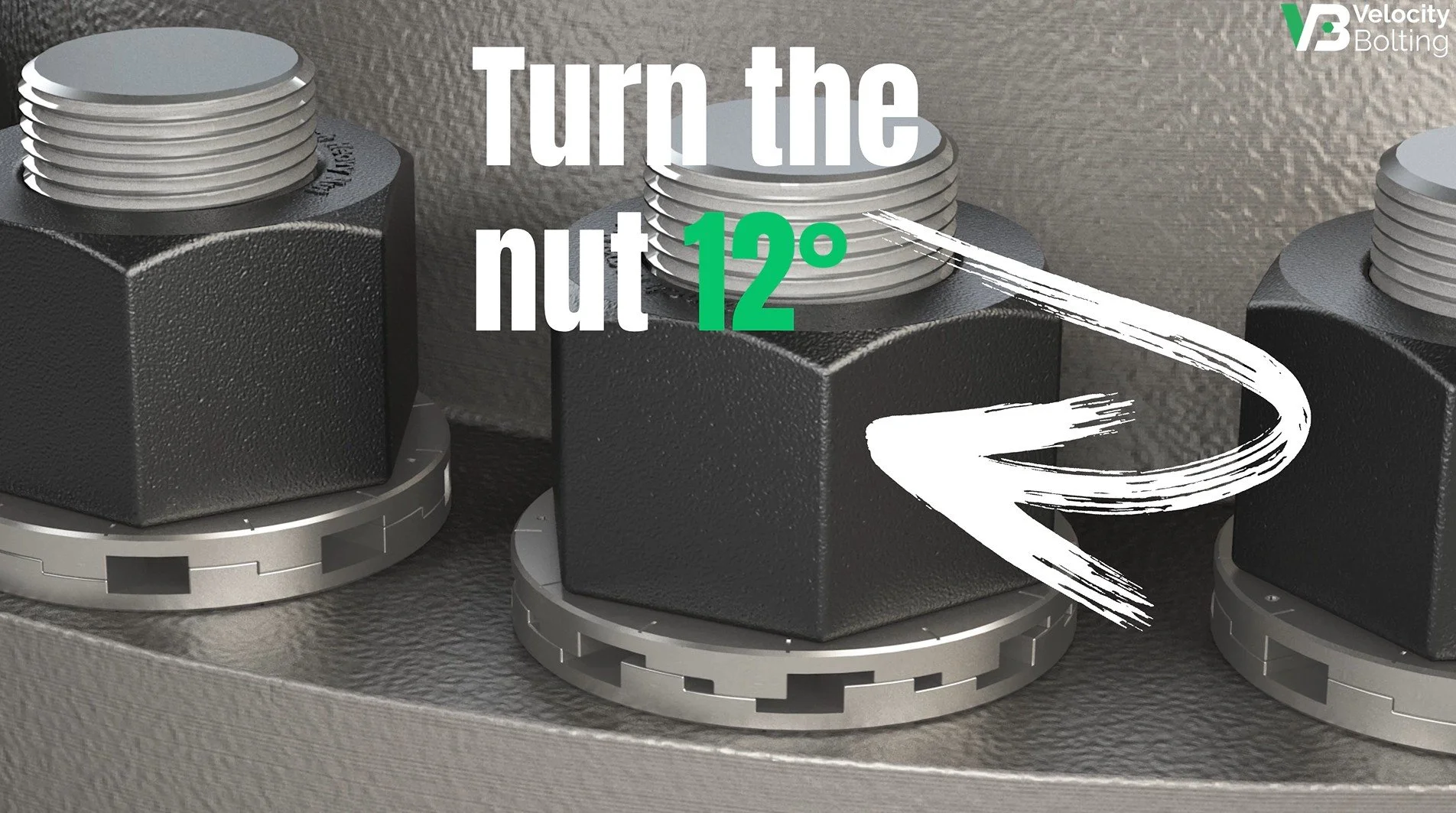
Mapping Velocity Washer to DIS goals
The most compelling alignment case is not that a washer “solves serviceability,” but that it targets a class of sustainment friction that DIS is explicitly trying to remove: unpredictable maintenance timelines, constrained workforce capacity, and supply chain vulnerability that reduce operational availability. [29]
Serviceability and reduced docking/maintenance downtime. DIS sets a maritime fleet serviceability target of 75% over 10 years. [9] DND reporting shows current serviceability below target and notes longer docking work periods for Halifax‑class frigates due to age. [2] DND’s evaluation explicitly links ageing‑fleet maintenance demand to DWP/EDWP overruns that reduce operational availability. [3] Velocity Washer’s core value proposition is reducing bolt breakout time variability by preventing galling and enabling fast disassembly with standard tooling, with published examples of large time reductions and avoided delays (112 hours, 94% faster disassembly). [30] The defensible inference is that, wherever seized fasteners appear on the critical path of docking or shore maintenance packages, a technology that reduces breakout uncertainty and rework risk directly supports higher serviceability.
Joint in‑service support and standardization across fleets. DIS explicitly treats In‑Service Support (Naval; Land; Air) as a sovereign capability area. [31] A drop‑in maintainability device that works with standard torque procedures, requires no specialized tooling, and is applicable to common bolted joints offers a pathway to standardized sustainment practice across platforms and fleets - an enabler for joint ISS constructs and shared support organizations. [32]
Sovereignty and “Build in Canada” sustainment capability. DIS’s Build–Partner–Buy approach prioritises building capacity domestically - especially in sovereign capabilities - and emphasizes sovereign control over operation and sustainment. [33] The Velocity Washer is owned by a Canadian firm with Canadian patent coverage. [34] For procurement audiences, the practical point is that sustainment‑critical innovations that can be produced and supported domestically are directly responsive to DIS’s sovereign capability framing - particularly because DIS consultation findings explicitly include ISS/MRO within sovereign capability definitions. [35]
Reduced logistics burden and supply‑chain resilience. DIS positions supply chain security as a pillar, explicitly describing efforts to strengthen supply chain security domestically and with trusted allies, and establishing programmes intended to increase domestic production capacity. [36] In parallel, the Auditor General concluded that National Defence often did not deliver requested materiel on time. [37] Velocity Washer’s sustainment logic is attractive from a logistics perspective because: it can reduce the need for destructive fastener removal (torches/grinders), reduce unplanned replacement of studs and nuts (reusability claims appear repeatedly), and can be stocked as a relatively small consumable item. [38] A plausible DIS‑aligned implementation pattern would be to stock washers as part of flange/joint maintenance kits at Fleet Maintenance Facilities and homeports to reduce downtime tied to parts shortfalls and emergent hot work.
Workforce capability and skills constraints. DIS is explicit about workforce development and the need to build skilled labour capacity (Canada Defence Skills Agenda). [39] DND’s evaluation also describes understaffing and high overtime pressures in Fleet Maintenance Facilities. [3] Velocity Washer’s argument here is not that it replaces skilled trades, but that it can reduce reliance on scarce specialist interventions (for example, cutting/fabrication or external bolt‑removal services) by making bolt disassembly feasible with standard tools and normal procedures. [22] This is a relevant complement to DIS’s skills agenda: simplification and standardisation reduce the peak skill burden per task and make schedule outcomes less sensitive to specialist availability.
Lifecycle sustainment and procurement models. DIS consultation findings explicitly support “multi‑year contracts and lifecycle sustainment models” to improve predictability and justify private investment in capacity. [40] The Velocity Washer value proposition is inherently through‑life: it is installed during assembly for the purpose of reducing friction at future disassembly, which is exactly the lifecycle logic DIS is attempting to institutionalize. [19] Given that operating and support can dominate life‑cycle costs in naval contexts (GAO cites ~70% for Navy ships), sustainment innovations with measurable reductions in labour hours and delays deserve procurement attention. [18]
Comparison with conventional bolting approaches
The table below contrasts Velocity Washer against conventional flange bolting/fastener removal approaches typically used when galling or seizure is a risk. The comparison is framed around defence sustainment outcomes (time, dock dependency, manning, logistics footprint, lifecycle cost pressure, and operational availability risk).
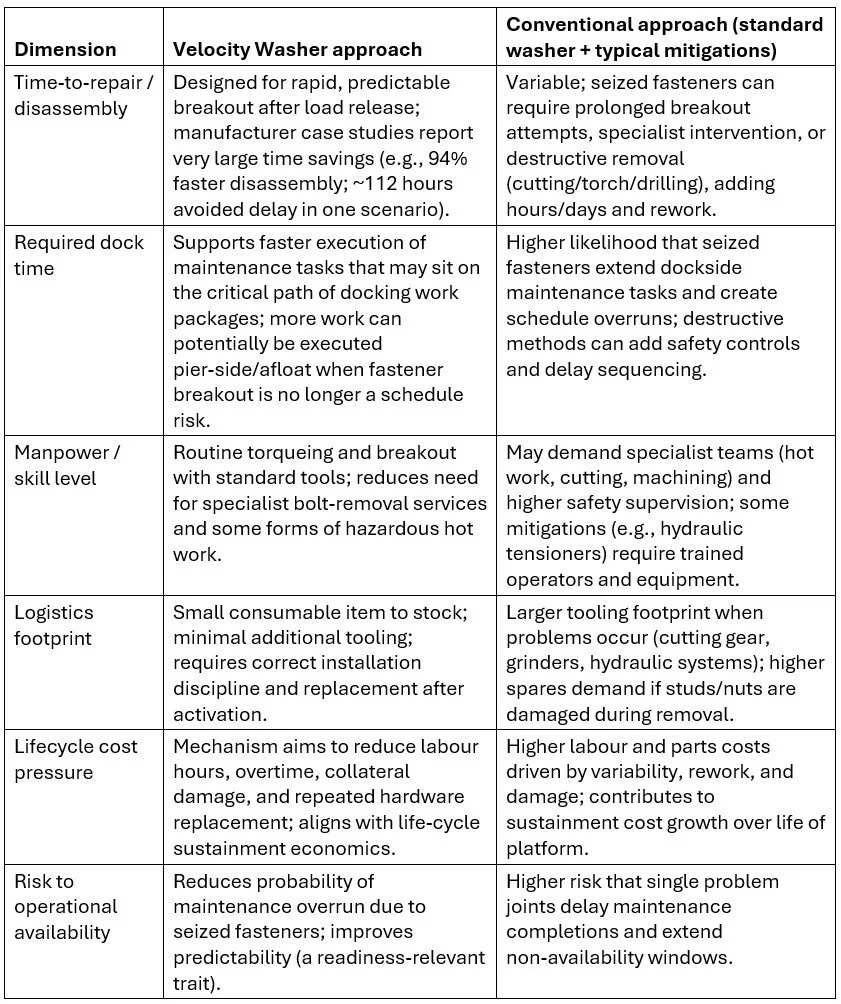
Evidence points for the Velocity Washer side of this comparison include manufacturer claims of “no special tools,” standard procedures, 12° activation, and the cited case study metrics for time reduction and avoided delays. [41] The readiness and availability sensitivity to maintenance duration is consistent with official defence reporting on docking work period overruns and serviceability impacts. [42]
Assumptions, data gaps, and a DIS‑aligned call‑to‑action
Several assumptions are unavoidable in a public, unclassified blog analysis:
Deployment scale is unspecified: this assessment assumes pilot‑scale adoption on selected high‑risk bolted joints (e.g., heat exchangers, valve bonnets, pumps) rather than fleet‑wide retrofit on every joint.
Vessel classes are not specified: the mapping uses publicly documented RCN sustainment challenges (e.g., docking work period overruns and serviceability shortfalls) without claiming class‑specific engineering integration details. [44]
Classified operational constraints are not addressed: shipboard system layouts, maintenance critical paths, and deployment readiness rules are often not public. The argument therefore focuses on general maintainability economics and publicly stated readiness constraints.
Data gaps worth flagging (and how to strengthen the claim set for defence procurement) are clear:
Independent naval trial data: Velocity’s published case studies are industrial (not naval). A structured trial (shipyard and pier‑side) that measures labour hours, schedule variance reduction, and reduction in destructive removal would materially strengthen procurement credibility.
Qualification evidence package: Velocity Bolting asserts conformance to naval vibration/shock MIL standards, which are relevant to shipboard environments. [7] Defence buyers would still want test reports, configuration control, and acceptance criteria mapped to Canadian naval requirements.
Supply chain and cost transparency: DIS emphasises supply chain resilience and lifecycle sustainment models. [45] For acquisition stakeholders, a clear bill of materials, manufacturing/lead‑time, and spares stocking concept (including the non‑reusability constraint after activation) would support value‑for‑money and availability modelling.
In‑service support integration: A disciplined installation standard and documentation approach matters. The published operation guide includes concrete installation constraints (side‑of‑wrench, no lubrication at flange interface, single‑washer use, no reuse, no left‑hand threads) that should be translated into shipyard work instructions and ISS contracts if adopted.

Call‑to‑action for procurement and sustainment stakeholders
If you are a procurement authority, fleet manager, or ISS prime working under the DIS, the most DIS‑aligned next step is to treat Velocity Washer as a serviceability pilot opportunity: select a small number of recurring, high‑delay bolt‑breakout tasks in docking work periods and at‑homeport maintenance, then measure (1) labour hours, (2) schedule variance, (3) hot‑work occurrences avoided, and (4) parts replacement rates before and after adoption. This aligns directly with DIS’s serviceability target focus and its prioritisation of In‑Service Support as a sovereign capability. [47]
DIS is signalling that Canada wants solutions that both strengthen sovereign sustainment capacity and produce readiness outcomes. A sustainment‑centred innovation that reduces maintenance uncertainty and docking downtime is exactly the kind of practical, measurable capability insertion that can help close Canada’s serviceability gap—while reinforcing the domestic industrial base that DIS is designed to grow. [48]
______
Disclaimer:
Portions of this article were generated with the assistance of ChatGPT, a large language model developed by OpenAI. The content is provided for informational purposes only and does not constitute professional, legal, financial, or academic advice. The views expressed do not necessarily reflect those of the author, and readers are encouraged to independently verify any information presented.
The AI-generated content has been reviewed and edited for clarity and accuracy where appropriate.