
Thermal Cycling and Bolt Relaxation: Why Critical Joints Lose Preload - and What to Do About It
Every time a bolted joint heats up and cools down, it loses a little of the clamp load holding it together. Here’s why relaxation happens, where it does the most damage, and how maintenance and engineering teams keep joints tight over the long haul.
A bolted joint is only doing its job as long as it stays tight. The preload installed during assembly — the tension stretched into the bolt and the compression squeezed into the flange and gasket — is what seals the joint, resists external loads, and holds off fatigue. But preload is not permanent. Over time, and especially under changing temperatures, it drains away through a process called bolt relaxation. In hot, cyclic service, a joint that was correctly tightened on day one can be leaking, loose, or failing months later — with no one having touched a wrench.
For maintenance and engineering teams, understanding relaxation is the difference between chasing recurring leaks and designing them out. This post breaks down the mechanisms behind thermally driven preload loss, why thermal cycling accelerates it, and the practical strategies used to manage it across industries.
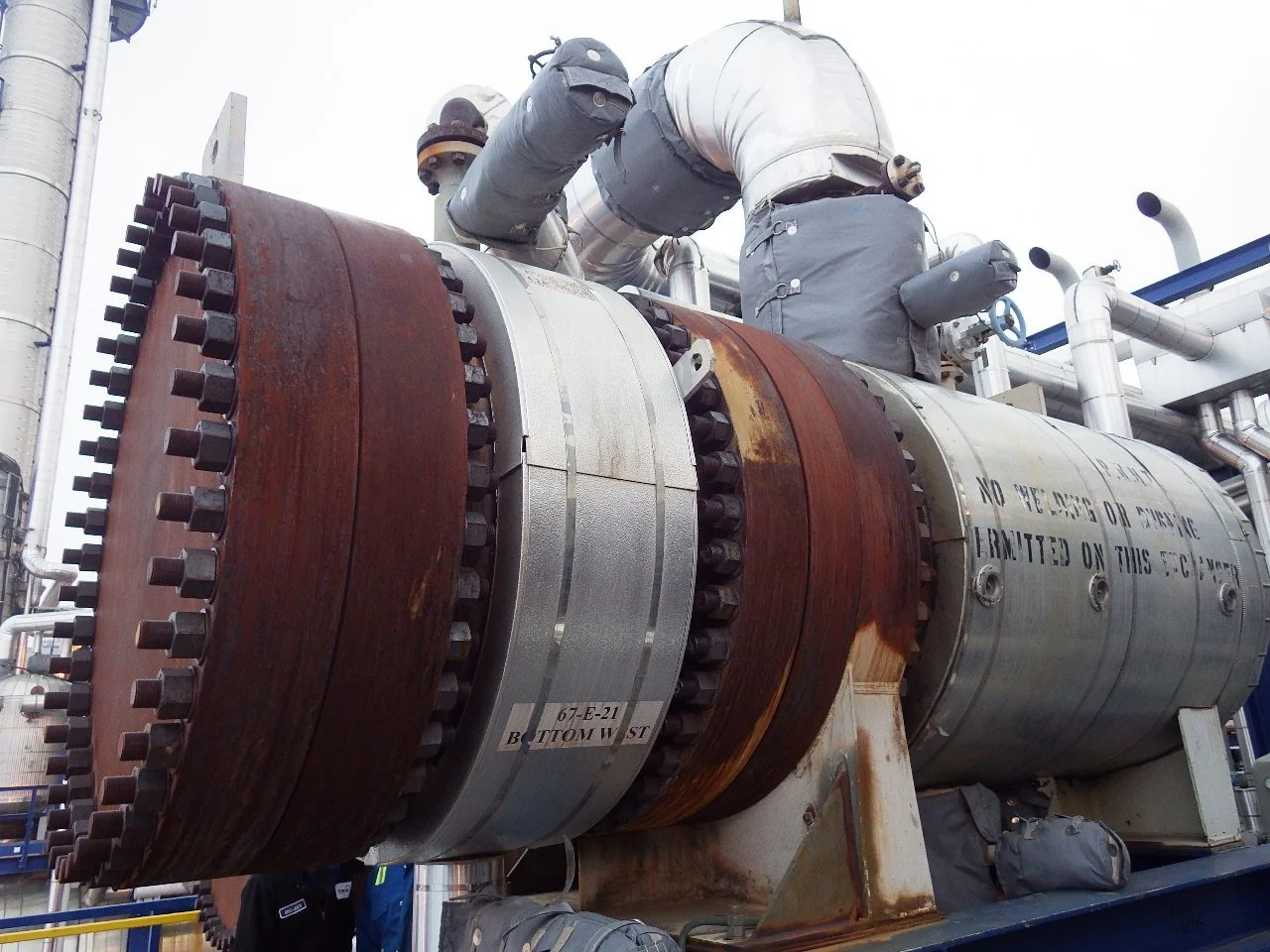
Heat exchangers (pictured), reactors, and hot piping are common areas to see thermal cycling. Relaxed joints mean flange leaks, fugitive emissions, and unplanned shutdowns.
Relaxation is not the same as self-loosening
When a joint loses clamp load, engineers often reach for the word “loosening” — but two very different phenomena are at work:
Self-loosening (rotational): the nut or bolt physically rotates back off the thread, usually driven by transverse vibration (the Junker mechanism). The fastener unwinds.
Relaxation (non-rotational): the fastener does not rotate at all, yet preload still falls. Clamp load is lost because material inside the joint deforms — asperities flatten, gaskets compress, metal creeps — reducing the elastic stretch stored in the bolt.
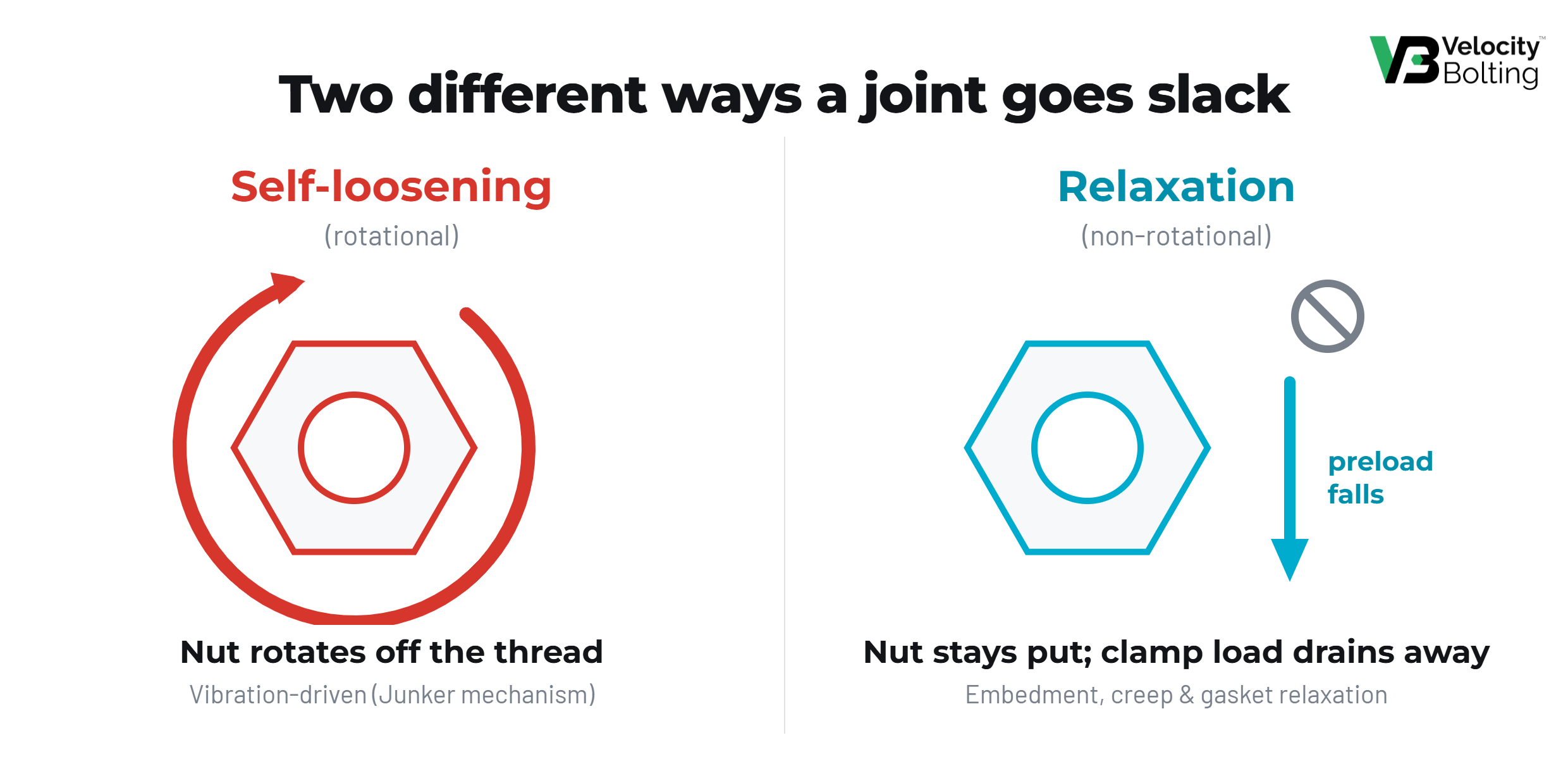
Thermal cycling drives the second category. The nut stays exactly where you left it; the joint quietly relaxes underneath it. Because nothing appears to move, relaxation is easy to overlook until a leak or failure reveals it.
The mechanisms of thermally driven preload loss
1. Differential thermal expansion
Bolts and the components they clamp are usually different materials with different coefficients of thermal expansion (CTE). As the assembly heats, each part grows at its own rate. If the clamped members expand more axially than the bolt, they push outward and preload rises; if the bolt grows more, preload falls. Temperature gradients make this worse — a bolt that heats slower than the surrounding flange (common at startup) sees a transient swing in tension.
A classic case: an austenitic stainless flange bolted with an alloy steel stud. Heat the joint and the higher-CTE flange stretches the bolt further, raising tension; cool it and tension drops back. Each cycle swings the bolt through a load range — and that cyclic range is what sets up the other loss mechanisms, and fatigue.
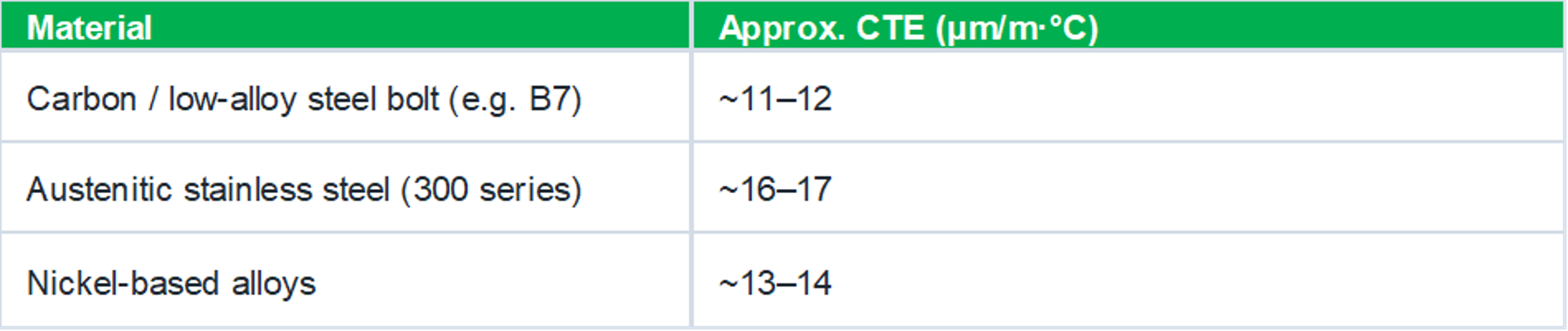
Indicative values for comparison only — confirm against material data for design.
2. Embedment (short-term relaxation)
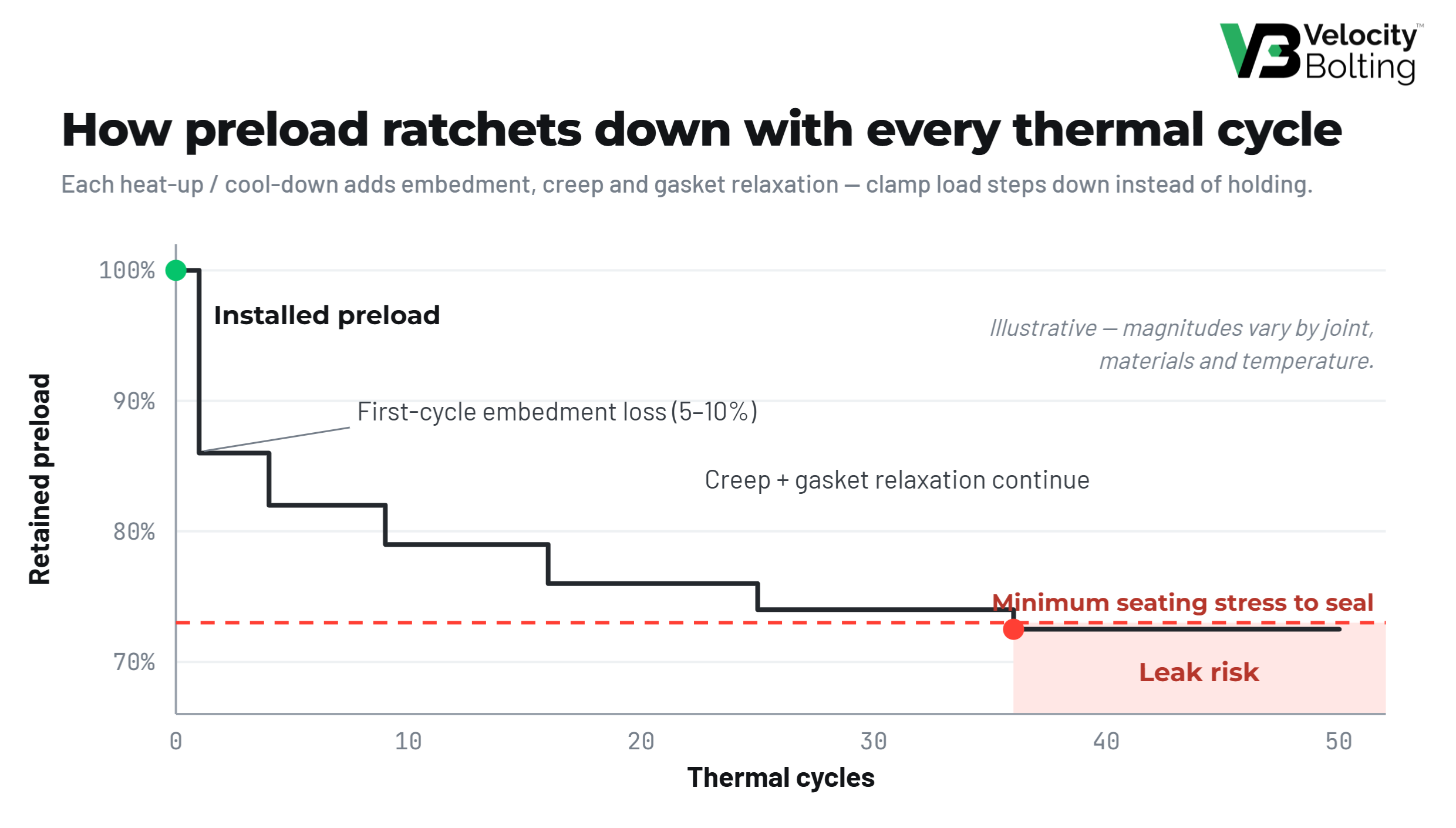
No machined surface is perfectly flat. Thread flanks, nut and washer bearing faces, and flange contact faces all carry microscopic high spots. Under preload these asperities are crushed flat, and every bit of that flattening is stretch the bolt loses. Embedment happens fast — mostly in the first hours and first few thermal cycles — and worsens at temperature, because material yield strength drops as things get hot. Typical embedment losses run 5–10% of installed preload, sometimes more on rough or coated surfaces.
3. Creep and stress relaxation
Hold a metal under load at high enough temperature and it slowly, permanently deforms — creep. In a bolted joint the reverse view is more useful: total strain is fixed by the joint geometry, so as the material creeps, stored elastic strain (your preload) converts into permanent set. This is stress relaxation. It becomes significant once bolt metal exceeds roughly 30–40% of its absolute melting temperature — a few hundred degrees Celsius for carbon and low-alloy steels — which is exactly where much process and power equipment operates.
4. Gasket creep relaxation
In flanged joints, the gasket is frequently the single largest contributor. Soft gasket materials — PTFE, compressed fiber, and to a lesser degree flexible graphite — creep and relax under sustained load and heat. As the gasket thins and relaxes, the flange faces move together, the bolts unload, and gasket seating stress falls below the level needed to seal. This is why gasket choice and re-torque practice matter so much in hot service.
Why thermal cycling is the real issue
Any one of these mechanisms causes some loss on its own. Thermal cycling is dangerous because it stacks them and repeats them.
Each heat-up / cool-down does several things at once: it swings the joint through a differential-expansion load range, adds another increment of embedment and creep at elevated temperature, and lets the gasket relax a little further. The result is ratcheting — preload steps down cycle after cycle rather than settling at a stable value. A joint might shrug off its first cycle and fail after fifty. Startup and shutdown transients are often the harshest part, because that is when temperature gradients across the joint are steepest and components move relative to one another the fastest.
Where it does the most damage
Thermal cycling and relaxation appear anywhere joints run hot and don’t stay at a constant temperature:
Refining and petrochemical: heat exchangers, reactors, and hot piping cycle with every startup, shutdown, and process swing. Relaxed joints mean flange leaks, fugitive emissions, and unplanned shutdowns.
Power generation: steam turbines, boilers, valves, and, in nuclear service, primary-loop components combine high sustained temperature with cyclic operation, a worst case for creep relaxation.
Marine and naval: propulsion engines, exhaust systems, and heat-rejection equipment cycle constantly with load and sea state, in an environment where access for maintenance is limited.
Chemical processing and any other hot pressurized or rotating equipment.
Across all of them the failure modes rhyme: lost seating stress and leaks, lost clamp load and joint separation, and cyclic loading that opens the door to fatigue and fretting.
Detecting and quantifying the loss
Torque is a poor proxy for residual preload — friction changes as surfaces oxidize and embed, so a “still tight” torque check can mask real tension loss. Better options:
Ultrasonic bolt measurement: measures actual bolt elongation before and after service, giving a direct read on retained preload.
Load-monitoring hardware: instrumented bolts or load cells on critical joints track relaxation in real time.
Documented re-check intervals: on known-cyclic joints, scheduled elongation checks build a relaxation curve you can plan maintenance around.
Managing relaxation: the practical toolkit
No joint fully escapes relaxation, but good practice keeps it within tolerance:
Build a resilient joint. A longer, more slender bolt stores more elastic stretch, so a fixed embedment loss is a smaller percentage of total preload. Higher joint-stiffness ratios ride out thermal movement with less preload swing.
Choose the right materials. Creep-resistant bolt alloys for the temperature (stepping up from B7 to B16, or to nickel-based grades in the hottest service) and CTE matching where practical reduce differential and creep losses.
Choose low-creep gaskets. Spiral-wound and kammprofile gaskets hold seating stress far better than soft sheet materials in cyclic hot service.
Install and verify preload properly. Controlled bolting — accurate patterns, calibrated methods, and verification by tensioning or ultrasonic measurement — starts the joint at a known, uniform load rather than a hopeful one.
Re-torque after thermal cycling. Because most embedment and gasket relaxation happens early, a planned hot re-torque (or re-tension) after the first heat cycle re-establishes lost preload and dramatically extends joint life. Standards such as ASME PCC-1 formalize assembly and re-torque practice for exactly this reason.
The maintenance reality and where hardware helps
Every mitigation that involves touching the joint after it has been in hot service — re-torquing, re-tensioning, or opening it up to replace a relaxed gasket — runs into the same wall: seized, galled fasteners. Studs that have spent hundreds of cycles at temperature tend to gall on disassembly, and the traditional answer is hot work: cutting, grinding, or burning them out. In hydrocarbon and other hazardous service, that is slow, expensive, and a genuine safety hazard.
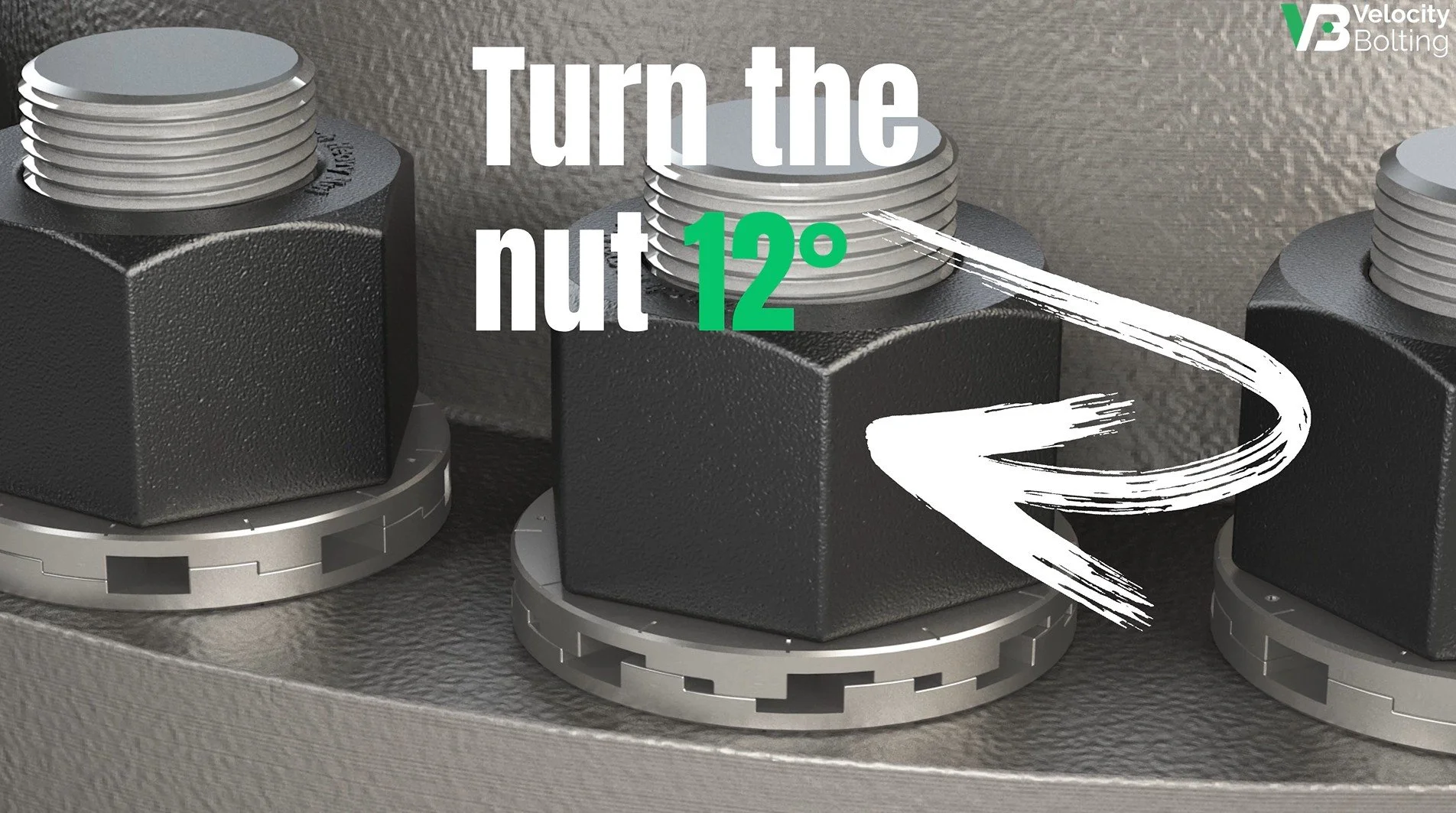
This is where the Velocity Washer fits in. It does not stop relaxation — nothing fully does — but it changes the economics of responding to it. By eliminating thread galling, it keeps critical joints serviceable, so the re-torques and teardowns that thermal cycling inevitably demands can be done quickly, cold, and safely — cutting seized-flange disassembly time by up to 95% without hot work. In a world where you will be going back into hot joints, keeping them easy to open is part of managing relaxation, not separate from it.
Thermal cycling makes preload loss a matter of when, not if. Designing joints to resist it, verifying preload properly, and planning re-torques are the front line — and keeping those joints galling-free is what makes the maintenance sustainable.
To learn more about how the Velocity Washer keeps critical bolted joints serviceable click here
____
Disclaimer:
Portions of this article were generated with the assistance of LLMs. The content is provided for informational purposes only and does not constitute professional, legal, financial, or academic advice. The views expressed do not necessarily reflect those of the author, and readers are encouraged to independently verify any information presented.
The AI-generated content has been reviewed and edited for clarity and accuracy where appropriate.