
Rolled vs. Cut Threads: Why a Line on the Purchase Order Shows Up During Turnaround
Torque values, gasket seating stress, target preload, lubricant friction factor - all of these get scrutinized before a bolted joint goes into service. How the thread itself was formed usually does not. It is treated as a commodity detail, invisible below the level of the specification.
It is not. Two threads that measure identically on a gauge and certify to the same standard can behave very differently after five years of thermal cycling.
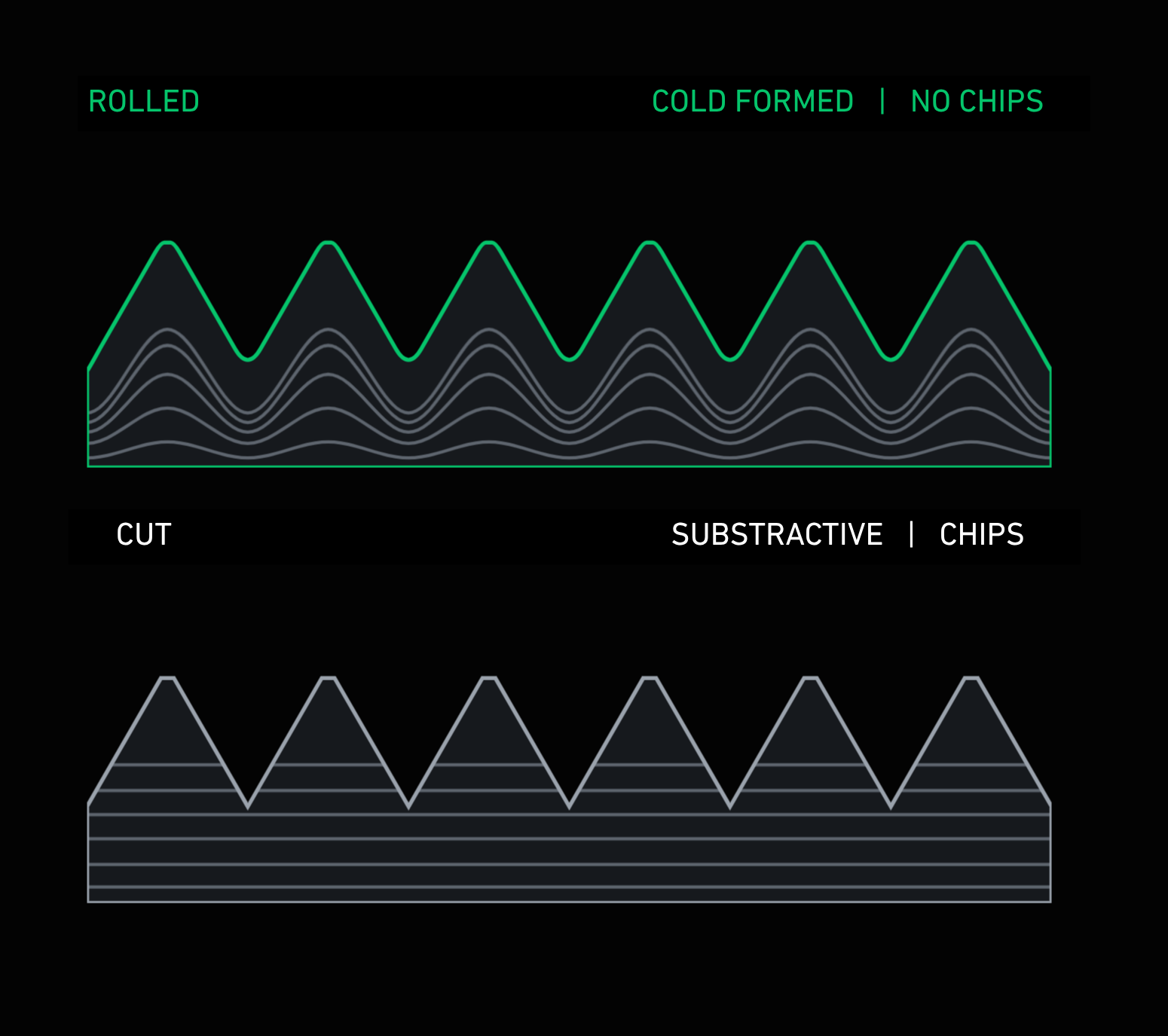
Thread manufacturing method rarely makes it into a flange joint calculation - but on a stud in cyclic service, or one that has to come apart at sea, it is the difference between a routine disassembly and a cutting torch.
Two ways to make a thread
Cutting is subtractive. A die, single-point tool, or tap removes material to leave the helical form. The blank starts at the major diameter and the thread is carved out of it. Chips come off.
Rolling is a cold-forming process. The blank starts near the pitch diameter and is fed between hardened dies that press the form into the surface, displacing material rather than removing it. Metal flows from what becomes the root outward to what becomes the crest. No chips.
That single difference — displaced versus removed — drives nearly everything that follows.
Why rolling wins on fatigue
Three mechanisms, all of them concentrated at the thread root, which is where fasteners actually fail.
Grain flow
In bar stock the grain runs axially. Cutting severs it, leaving grain ends exposed at the root — precisely the location of peak stress concentration. Rolling bends the grain so it follows the thread contour, wrapping continuously around the root instead of terminating in it.
Work hardening
Cold deformation raises local yield strength in the most heavily worked region of the formed thread, which is the root.
Compressive residual stress
Rolling leaves the root in residual compression. A fatigue crack must first overcome that compressive field before applied tensile stress can begin opening it. Published comparisons commonly place the fatigue-life improvement of rolled over cut threads anywhere from roughly 30% to well over 100%, depending on material, load ratio, and, whether rolling was performed before or after heat treatment.
Rolling also produces a more generous and more consistent root radius than a cutting die that has drifted toward the end of its life, which lowers the stress concentration factor independently of the residual stress benefit.
For flange bolting on reciprocating compressors, pumps subject to pressure pulsation, or hull and machinery-seat fasteners exposed to shock and vibration, none of this is academic.
Roll before or roll after heat treatment
For fasteners above roughly 150 ksi tensile — high-strength socket head cap screws to ASTM A574, or high-strength alloy studs — when you roll matters as much as whether you roll.
Roll-before-heat-treat (RBHT). The beneficial residual stress and cold work are largely relieved during subsequent austenitizing and tempering. You keep the favourable grain flow; you lose most of the compression.
Roll-after-heat-treat (RAHT). The thread is formed into fully hardened material. Harder on tooling, more expensive, lower throughput — and substantially better in fatigue. Aerospace and other critical-application specifications frequently mandate it for exactly this reason.
ASTM A193 B7 studding is sold both cut and rolled against the same specification. If you need rolled, say so on the requisition — it will not arrive by default.
Where cut threads still make sense
Rolling is not universally superior; it is process-constrained. Cutting remains the right answer in several situations:
Large diameters. Rolling forces scale with diameter and material strength. Above roughly 1½ in. the required machine base becomes specialized and the economics shift.
Hard or work-hardening alloys. Some nickel-base and duplex materials resist forming or crack at the crest.
Non-standard geometry. Custom pitches, tapered forms, and modified profiles are cut.
Field work. No one carries a thread roller offshore. Chasing damaged threads on site is a cutting operation.
Short runs. Die setup cost only amortizes over volume.
Tl;dr - rolled where you can, cut where you must, and specify it deliberately either way.
Surface finish, friction, and galling
There is a second-order consequence that matters more in refining and naval service than fatigue does.
Rolled threads are burnished by the dies. Surface roughness is substantially lower than the tool-marked flanks of a cut thread. Because galling is adhesive wear — asperities on two mating surfaces contacting under high local pressure, cold-welding, then tearing — reducing asperity height reduces the number of initiation sites available.
That matters most on materials predisposed to gall. Austenitic stainless such as ASTM A193 B8 and B8M, nickel alloys, and titanium all form a thin protective oxide layer that is disrupted by sliding contact, exposing clean and chemically active metal that readily bonds to whatever it is sliding against. On these materials, a rolled thread measurably lowers galling risk relative to a cut one.
It lowers it. It does not eliminate it.
The limit of a better thread
This is where thread quality runs out of road. In a torqued joint, a large share of applied torque — commonly cited as roughly half — is consumed by friction under the nut bearing face, not in the threads at all. That interface carries the full clamp load sliding across it during tightening. Surface finish on the thread flank does nothing for it.
Which is why crews on refinery turnarounds and naval maintenance periods still meet studs that will not come apart, with rolled threads, correct anti-seize, and good procedure. Corrosion products, thermal cycling, and thousands of hours in service produce seizure at both interfaces. When conventional removal fails, the fallback is hot work — with the hot work permits, isolation, and schedule impact that entails.
The Velocity Washer addresses the interface a better thread cannot reach. In service it eliminates galling at that interface and has reduced seized-flange disassembly time by up to 95% without hot work — performance validated through US Navy nuclear-grade testing for the Columbia-class submarine and Gerald R. Ford-class carrier programs.
Specify rolled threads. Then solve the other half of the problem with Velocity Washer.